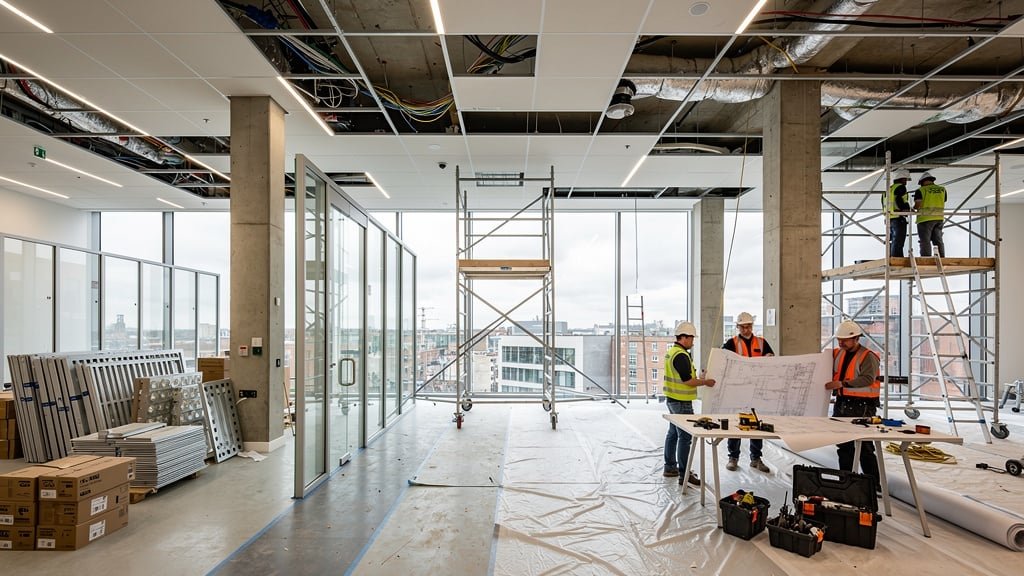
My Commercial Building Surveyors manage commercial property refurbishment projects ranging from small tenant fit-outs to multi-million-pound building transformations. Through decades of combined experience, our RICS chartered surveyors have developed proven processes that deliver successful refurbishment outcomes on time, within budget, and to exacting quality standards.
This comprehensive guide walks building owners and property developers through every stage of commercial property refurbishment planning—from initial concept and feasibility through design, procurement, construction, and final handover. Understanding this process helps you avoid costly mistakes, manage risks effectively, and achieve refurbishment objectives that enhance property value and tenant satisfaction.
Critical Success Factor: Commercial property refurbishment projects fail when planning is inadequate. My Commercial Building Surveyors emphasize thorough preparation, comprehensive surveys, realistic budgeting, and expert project management to ensure refurbishment success.
Why Commercial Properties Need Refurbishment
Building owners undertake refurbishment projects for various strategic reasons:
1. Tenant Requirements and Lease Renewals
Existing tenants approaching lease expiry often require updated facilities, modern services, or reconfigured spaces to support evolving business needs. Refurbishment enables lease renewals that maintain rental income and avoid void periods.
2. Attracting Quality Tenants
Outdated commercial properties struggle to attract premium tenants willing to pay competitive rents. Modern refurbishment addressing contemporary workplace expectations secures better tenants at higher rental values.
3. Regulatory Compliance
Building Regulations, fire safety legislation, accessibility requirements (Equality Act 2010), and energy performance mandates evolve continuously. Refurbishment ensures compliance avoiding enforcement action and enabling lawful occupation.
4. Asset Value Enhancement
Strategic refurbishment significantly increases property capital values. My Commercial Building Surveyors have managed projects delivering 20-40% value uplifts through comprehensive modernization programs.
5. Operational Efficiency
Modern mechanical and electrical systems reduce operational costs through improved energy efficiency. Refurbishment replacing obsolete plant with contemporary installations can reduce running costs by 30-50%.
Phase 1: Initial Assessment and Feasibility (Weeks 1-4)
🔍 Step 1: Comprehensive Building Survey
Every refurbishment project begins with detailed building surveys identifying existing conditions, defects requiring rectification, and constraints affecting design options.
Our building surveyors assess:
- Structural condition and capacity for alterations
- Services installations condition and remaining life
- Asbestos presence requiring management or removal
- Fire safety compartmentation and means of escape adequacy
- Building Regulations compliance gaps
- Accessibility for disabled persons
- External fabric condition and weatherproofing
📐 Step 2: Measured Survey and Space Planning
Accurate measured surveys provide dimensional data for design development. My Commercial Building Surveyors produce detailed floor plans showing:
- Existing room layouts and dimensions
- Structural elements (columns, beams, load-bearing walls)
- Services distribution (risers, plant locations, distribution routes)
- Circulation spaces and means of escape routes
- Gross internal area (GIA) and net internal area (NIA) calculations
💰 Step 3: Budget Development and Feasibility
Realistic budget setting is critical. Quantity surveyors prepare cost estimates covering:
- Construction costs: Building works, M&E installations, finishes (typically £150-£450 per m² for commercial refurbishment)
- Professional fees: Architects, engineers, project managers, surveyors (typically 8-15% of construction cost)
- Statutory fees: Building Regulations, planning applications, party wall agreements
- Contingencies: Allowances for unforeseen works (typically 10-20% depending on project risk)
- Furniture and equipment: If tenant fit-out included
- Decant costs: Temporary accommodation if phased occupation required
Phase 2: Design Development and Approvals (Weeks 5-12)
Appointing the Design Team
Successful refurbishment requires coordinated professional teams:
- Architect: Overall design coordination, aesthetic vision, Building Regulations compliance
- Structural engineer: Assessment of structural alterations, new openings, load calculations
- M&E consultant: Mechanical, electrical, and plumbing design ensuring adequate capacity
- Building surveyor/project manager: Oversees entire project, coordinates consultants, manages contractors
- Quantity surveyor: Cost management, tender analysis, valuation of works
- CDM coordinator: Health and safety compliance under Construction (Design and Management) Regulations
Design Stages
1. Concept Design (RIBA Stage 2)
High-level design establishing overall approach, spatial arrangements, and aesthetics. Key decisions about layout reconfiguration, services strategy, and specification standards.
2. Developed Design (RIBA Stage 3)
Detailed design resolving technical coordination between architectural, structural, and M&E elements. Building Regulations compliance strategies finalized.
3. Technical Design (RIBA Stage 4)
Production information for contractor tender and construction. Detailed drawings, specifications, and schedules enabling accurate pricing and construction.
Statutory Approvals
Commercial refurbishment projects require various regulatory approvals:
- Planning permission: Material external alterations or change of use require planning consent (6-13 weeks processing)
- Building Regulations approval: All structural alterations, services installations, fire safety works require Building Control approval
- Listed building consent: Grade I, II*, or II listed properties require special approvals (8-13 weeks)
- Party wall agreements: Works affecting adjoining properties require Party Wall Act notices (typically 2 months)
Need Expert Refurbishment Project Management?
Our RICS chartered surveyors provide comprehensive project management services for commercial property refurbishment from feasibility through completion.
Get Your Project QuotePhase 3: Contractor Selection and Procurement (Weeks 13-16)
Tendering Process
My Commercial Building Surveyors manage competitive tender processes ensuring value for money and contractor quality:
Single-Stage Competitive Tender
- Issue complete tender documentation to 3-5 selected contractors
- 2-3 week tender period for pricing
- Tender analysis comparing price, program, methodology
- Interview shortlisted contractors before appointment
Two-Stage Tender (Complex Projects)
- Stage 1: Select preferred contractor based on preliminaries and overheads
- Stage 2: Collaborate on design development before final price agreement
- Suitable for fast-track projects or design-and-build procurement
Contractor Assessment Criteria
- Price competitiveness: But not lowest price alone—value for money considering quality
- Experience: Demonstrated track record in similar commercial refurbishment
- Financial stability: Credit checks ensuring contractor solvency
- Insurance coverage: Adequate PI, public liability, and contract works insurance
- Health and safety: CHAS, Constructionline, or equivalent accreditation
- Program: Realistic construction timescales and resource allocation
- References: Verification of past project performance
Phase 4: Pre-Construction and Mobilization (Weeks 17-18)
Pre-Start Activities
- Contract execution: Formal appointment under JCT, NEC, or bespoke contract terms
- Pre-start meeting: Confirm program, communication protocols, site logistics
- Insurances: Verify all required policies in place before site access
- CDM compliance: Construction Phase Plan approval by Principal Designer
- Site setup: Welfare facilities, hoarding, access arrangements, security
- Asbestos removal: Licensed removal of ACMs before refurbishment commences
- Services disconnections: Coordinated utility isolations and diversions
Phase 5: Construction and Contract Administration (Variable Duration)
Project Management During Construction
My Commercial Building Surveyors provide comprehensive contract administration throughout construction:
Regular Site Inspections
- Weekly site visits monitoring progress, quality, and compliance
- Photographic records documenting work stages
- Snagging lists identifying defects requiring correction
- Health and safety audits ensuring contractor compliance
Progress Meetings
- Fortnightly meetings reviewing program, quality, costs, risks
- Coordination of design team responses to contractor queries
- Resolution of site issues preventing delay
- Review of variations and their cost/program implications
Financial Management
- Valuation of completed works for interim payments
- Assessment of variation accounts and contract adjustments
- Cost reporting against budget with forecast final account
- Management of cash flow ensuring contractor solvency
Quality Control
- Material approvals ensuring specification compliance
- Workmanship inspections at critical stages
- Testing and commissioning of services installations
- Independent inspection of structural works
Common Refurbishment Challenges
1. Unforeseen Conditions
Hidden defects discovered during strip-out—structural movement, concealed services, contamination. My Commercial Building Surveyors' pre-refurbishment surveys minimize these surprises, but contingency allowances remain essential.
2. Occupied Building Constraints
Refurbishment while tenants remain in occupation requires careful phasing, noise control, dust suppression, and maintained egress routes. Programming complexity increases costs but avoids rental income loss.
3. Program Delays
Lead times for specialist components, adverse weather, unforeseen complications can delay completion. Proactive program management and early procurement of long-lead items mitigate delays.
4. Budget Overruns
Scope creep, variations, inflation, and unforeseen works threaten budgets. Rigorous change control, value engineering, and client discipline on variation acceptance control costs.
Phase 6: Completion and Handover (Final 2-4 Weeks)
Pre-Completion Activities
- Snagging inspections: Detailed review identifying all defects requiring rectification
- M&E commissioning: Testing and balancing of all services installations
- Building Regulations final inspection: Sign-off by Building Control
- Fire safety certification: Fire Risk Assessment and evacuation strategy
- Air tightness and acoustic testing: Compliance verification where required
- Cleaning: Deep clean removing construction dust and debris
Handover Documentation
Comprehensive handover information includes:
- As-built drawings: Accurate record of completed installation
- Operation and maintenance manuals: For all services plant and equipment
- Warranties and guarantees: Manufacturer warranties and installer certifications
- Test certificates: Electrical, fire alarm, emergency lighting, water systems
- Building Regulations completion certificate: Evidence of compliance
- Health and Safety File: Information for future works under CDM Regulations
- Training: Building user instruction on systems operation
Practical Completion and Defects Liability
- Practical completion: Formal certification that works are substantially complete and building can be occupied
- Retention release: Typically 5% of contract sum released at practical completion, 2.5% retained
- Defects liability period: Usually 12 months during which contractor rectifies emerging defects
- Final inspection: End of defects period review before final retention release
- Final account: Agreement of final contract sum including all variations
Post-Completion: Operational Phase
Building Performance Monitoring
My Commercial Building Surveyors recommend 12-month post-occupancy evaluation assessing:
- Energy consumption vs. design predictions
- Tenant satisfaction with refurbished facilities
- M&E systems performance and reliability
- Identification of any defects requiring rectification under warranty
Ongoing Maintenance Planning
Refurbished properties require planned preventative maintenance protecting investment:
- Annual services contracts for mechanical and electrical systems
- Regular fabric inspections identifying developing defects
- Compliance testing (fire alarms, emergency lighting, LEV, water systems)
- 5-year maintenance forecasting budgeting for component replacements
Refurbishment Budget Breakdown (Typical Office Refurbishment)
For a 5,000 m² office building refurbishment (£2 million total budget):
- Strip-out and demolition: £100,000 (5%)
- Structural works: £150,000 (7.5%)
- M&E installations: £600,000 (30%)
- Internal fit-out and finishes: £500,000 (25%)
- External works: £100,000 (5%)
- Professional fees: £240,000 (12%)
- Contingencies: £200,000 (10%)
- Furniture and IT: £110,000 (5.5%)
Cost Management Tip: Commercial refurbishment costs vary dramatically (£150-£450+ per m²) depending on specification, existing condition, and complexity. Early cost planning with quantity surveyors prevents budget shocks during design development.
Common Refurbishment Mistakes to Avoid
1. Inadequate Survey and Investigation
Skipping thorough pre-refurbishment surveys leads to unforeseen conditions, program delays, and budget overruns. Invest in comprehensive building surveys, asbestos surveys, and structural assessments upfront.
2. Unrealistic Budgets
Underestimating refurbishment costs causes mid-project compromises damaging quality. Use experienced quantity surveyors for realistic cost planning including adequate contingencies.
3. Value Engineering Too Early
Cutting scope or specification before understanding true costs often produces false economies. Complete design before value engineering exercises.
4. Poor Contractor Selection
Choosing contractors solely on lowest price creates quality and completion risks. Assess contractor competence, financial stability, and track record comprehensively.
5. Insufficient Project Management
Clients attempting self-management without construction expertise face delays, cost overruns, and quality failures. Appoint experienced building surveyors or project managers to oversee refurbishment.
Conclusion: Successful Refurbishment Through Expert Planning
Commercial property refurbishment delivers exceptional returns when planned and executed professionally. My Commercial Building Surveyors have managed hundreds of successful refurbishment projects protecting client investments, controlling costs, managing programs, and ensuring quality outcomes.
The complexity of commercial refurbishment—regulatory compliance, contractor management, cost control, design coordination—demands expert professional support. Our RICS chartered surveyors provide comprehensive project management services from initial feasibility through final handover, ensuring refurbishment projects achieve objectives on time and within budget.
Whether you're planning tenant fit-out, modernizing building services, or undertaking comprehensive refurbishment, professional guidance from experienced building surveyors protects your investment and delivers successful outcomes.
Start Planning Your Refurbishment Project
Contact our RICS chartered surveyors for expert refurbishment planning, project management, and contract administration services.
Request Your Free Consultation